Copy the prompt text below and adapt the parameters to fit your vision.
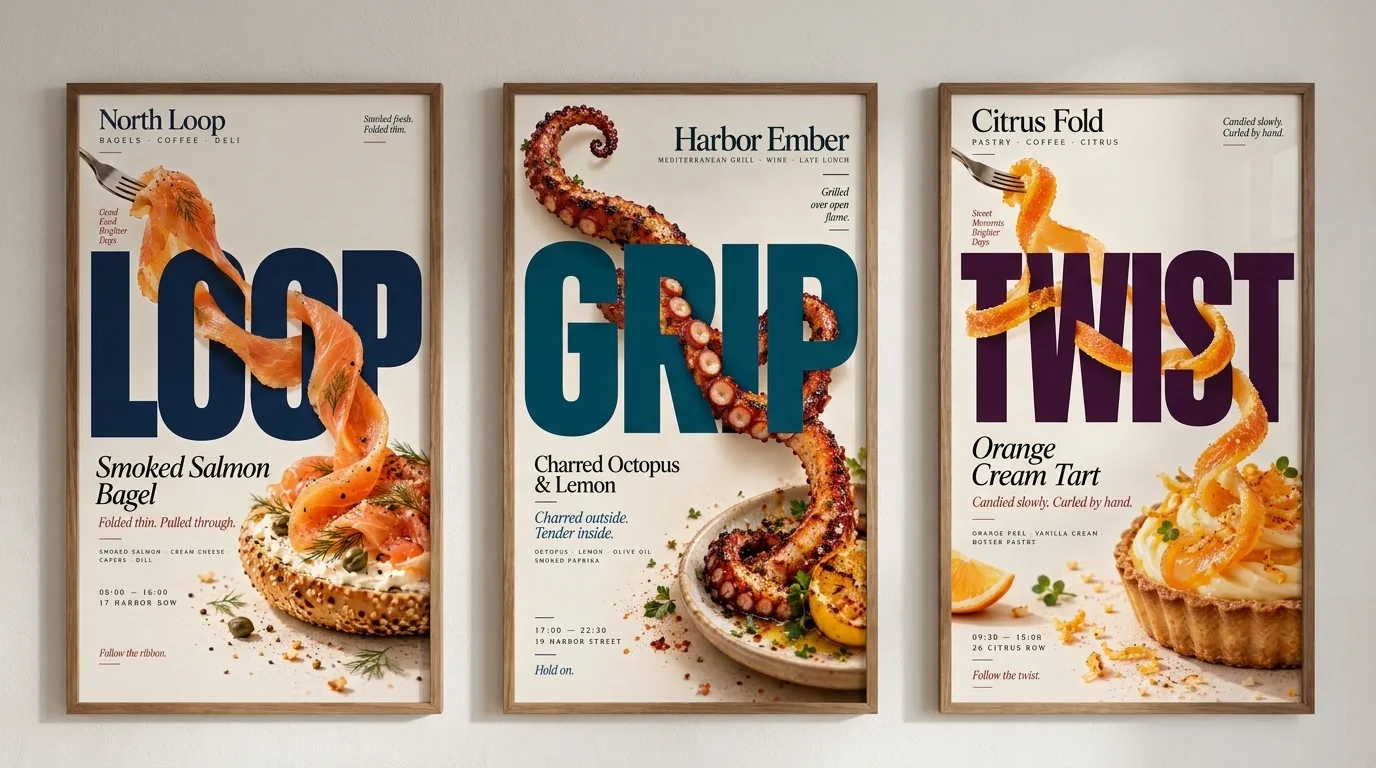
Create a 9:16 vertical food editorial poster for {{BRAND_NAME}}, featuring {{PRODUCT_NAME}} and combining highly realistic food photography with large, professionally designed typography.

Use a warm cream or ivory background with subtle paper texture, clean editorial composition, minimal props, controlled shadows, and premium commercial food photography.

Keep {{HEADLINE_TEXT}} large, flat, sharp, bold, and fully readable.

The food must remain a real, independent ingredient and physically travel through the typography according to {{INTERACTION}}.

Use {{FOOD_ELEMENT}} as the hero interaction element.

PHYSICAL INTERACTION:

For “through counters”:
Let {{FOOD_ELEMENT}} clearly enter and exit the open counters and negative spaces inside individual letters. Create believable front and back occlusion so portions of the food naturally disappear behind the typography and reappear through the letter openings.

For “grip letters”:
Let a natural structural part of {{FOOD_ELEMENT}} physically attach to, wrap around, grip, or hold one letter while the typography itself remains completely unchanged. The letter must retain its original geometry.

For “wrap around strokes”:
Use one continuous edible element to travel in front of, behind, and around different letter strokes. Give the food a clearly traceable path through the composition with believable depth and consistent physical continuity.

For “fold through type”:
Use a broad, flexible {{FOOD_ELEMENT}} with visible thickness and authentic food texture. Make it fold naturally between the front, back, and negative spaces of the letters, with realistic creases, overlaps, occlusion, and material behavior.

DEPTH AND PHYSICAL REALISM:

Every interaction must have clearly understandable depth.

Food positioned in front of typography should create subtle contact shadows and natural highlights.

Food positioned behind typography must be genuinely occluded rather than digitally simulated.

Maintain continuous:
- food texture
- thickness
- direction
- color
- surface detail
- lighting
- material behavior

The viewer should be able to visually trace the same ingredient through the entire interaction.

Do not turn food into letters.

Do not use food textures to fill typography.

Do not reshape the typography into food.

Do not rely on digital warp, fake extrusion, generic 3D effects, or artificial clipping.

TYPOGRAPHY:

Make {{HEADLINE_TEXT}} the primary graphic element.

Typography should be:
- large
- flat
- sharp
- professionally typeset
- geometrically clean
- immediately readable at thumbnail size

Use {{ACCENT_COLOR}} for the headline while maintaining strong contrast against the warm cream background.

Keep the letterforms structurally intact throughout the physical interaction.

COLOR AND DETAILS:

Use {{ACCENT_COLOR}} with natural food colors, warm cream, ivory, and dark neutrals.

Add only a few meaningful editorial details:
{{BRAND_NAME}}
{{PRODUCT_NAME}}
{{DETAILS}}

Use restrained typography and spacing so supporting information never competes with the hero headline or food interaction.

COMPOSITION:

Create a premium stop-scroll editorial composition with:
- one bold headline
- one recognizable food element
- one immediately understandable spatial interaction
- minimal supporting details
- generous but controlled negative space
- clean visual hierarchy

The final image should feel like a sophisticated contemporary restaurant, café, bakery, or food-brand campaign.

Use highly realistic food photography, natural imperfections, believable edible materials, refined studio lighting, subtle contact shadows, crisp typography, and premium editorial art direction.

--- Negative Prompt ---
CGI food, plastic food, fake ingredient, food transformed into letters, food typography texture, food-filled letters, warped typography, melted typography, distorted letters, generic 3D type, fake extrusion, digital warp, artificial clipping, impossible depth, floating food, disconnected food, broken food continuity, inconsistent thickness, inconsistent lighting, missing occlusion, incorrect front-back layering, no contact shadows, excessive shadows, unrealistic food texture, artificial ingredients, excessive props, clutter, dirty background, excessive paper texture, unreadable headline, misspelled text, distorted typography, random logos, watermark, QR code, decorative food overload, cartoon food, illustration, low resolution, blurry details, oversaturated colors, messy composition.
 ChatGPT
 Midjourney