




CERN and Mistral just teamed up to build "Flare"
On October 15, 2026, CERN and Mistral signed a statement of intent establishing a long-term strategic partnership for AI-for-science. At its heart: the ambition to develop a single pretrained Large Physics Model — the first foundation model for collider physics — trained on billions of simulated proton-proton collisions at the Large Hadron Collider. The partnership pairs CERN's expertise in fundamental physics, scientific data and large-scale computing with Mistral's leadership in large-scale model training. Reuters reports the model is called "Flare", though no timeline or budget has been disclosed.
What exactly is a Large Physics Model?
Think of it like a large language model — but instead of pretraining on text scraped from the web, it is pretrained on billions of simulated particle collisions. Today, reconstructing an LHC collision means running a chain of specialized algorithms that progressively transform raw detector signals into particles and physics objects used for analysis. The foundation-model idea is to learn across that whole reconstruction chain and serve multiple tasks with one pretrained model: reconstructing particle collisions, identifying particles, flagging unexpected signals, and evaluating future detector designs.
The data scale behind it
- ~1 exabyte (one million terabytes) of LHC experimental data stored at CERN
- Trained on billions of simulated proton-proton collisions
- HL-LHC upgrade (expected ~2030) will increase collision volume tenfold
- Existing algorithms per task vs one foundation model across the whole chain
What it is NOT (yet)
This is a statement of intent, not a finished model and not a contract. CERN's release gives no model size, no compute figure, no collision count beyond "billions", and no delivery date. It does not say whether model weights will be published. The "Flare" name comes from Reuters reporting, not CERN's release itself. Treat everything below the announcement as ambition to watch, not results to cite.
Flare vs other AI-for-science efforts
| Effort | Approach | Status |
|---|---|---|
| Flare (CERN + Mistral) | Foundation model trained on simulated collisions | Statement of intent (Oct 15, 2026) |
| Simons $15M math initiative (Simons + Anthropic + OpenAI) | Funding + tools to verify AI-generated proofs | Announced Oct 15, 2026, open call for proposals |
| Traditional ML in particle physics | Per-task specialized models | In production for a decade at CERN |
| LLM-based scientific assistants | Text models for papers and code | Widely deployed; not physics-grounded |
How creators can cover science AI stories with prompts
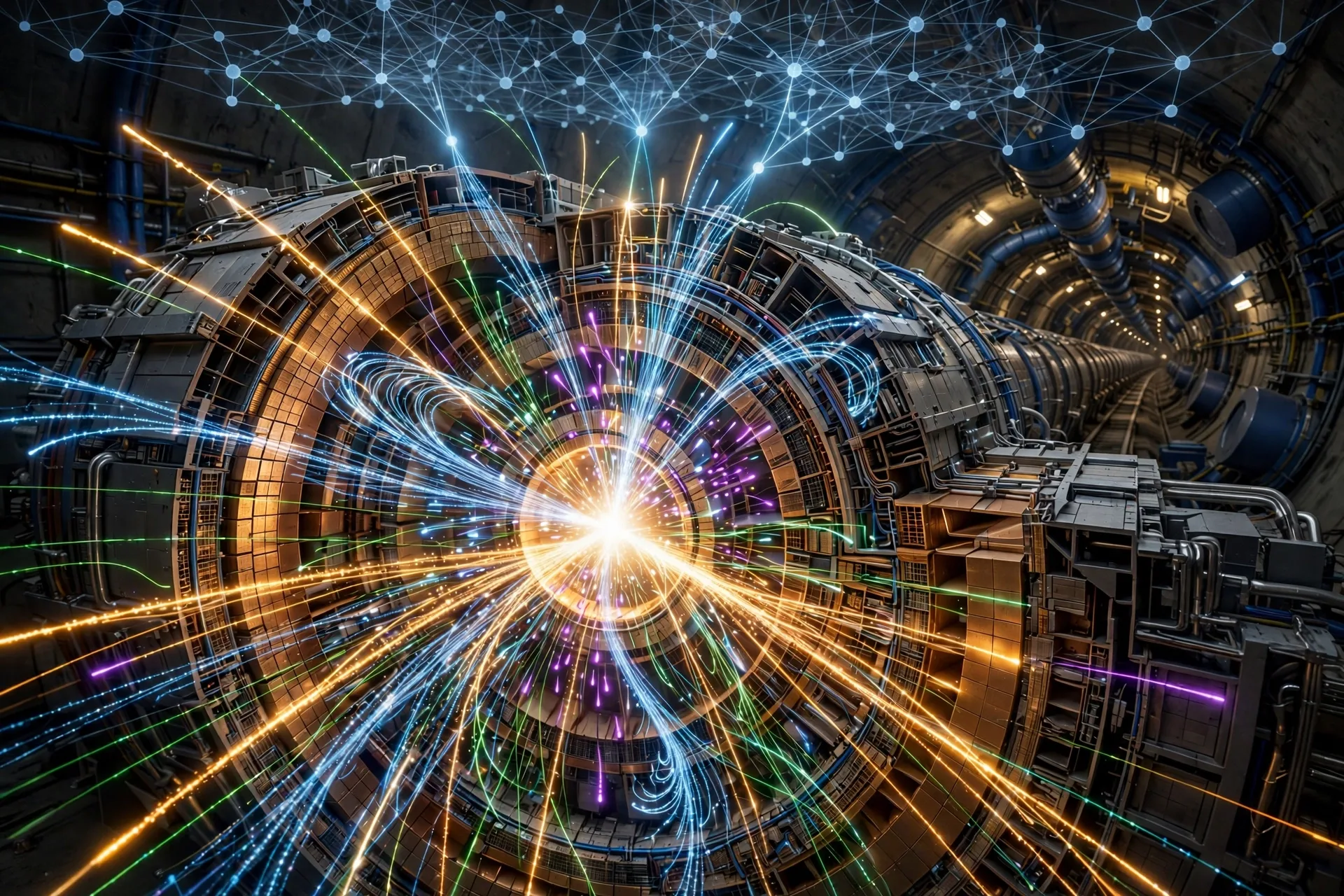
Flare is the perfect case study for a prompt workflow: the news is an ambition, not a result — so the honest creative angle is visualization and explanation, not hype. Prompt image models for the science, not the press release: particle tracks, detector cross-sections, collision events.
Editorial science illustration of a Large Hadron Collider collision event: thousands of glowing particle tracks spiraling outward from a central collision point, color-coded by particle type (blue muons, orange photons, green jets), inside a cutaway view of a cylindrical particle detector with layered tracking chambers, dark cosmic background, cinematic lighting, ultra-detailed, scientific visualization style, 16:9.
Frequently Asked Questions
What is Flare?
Flare is the reported codename (via Reuters) for the Large Physics Model that CERN and Mistral aim to build — the first foundation model for collider physics, trained on billions of simulated LHC collisions. It is a planned project announced October 15, 2026, not a finished model.
When will Flare be released?
No timeline has been disclosed. CERN and Mistral signed a statement of intent — a partnership framework, not a product announcement with a ship date.
What will the model actually do?
According to CERN's release, it's designed to support reconstructing particle collisions, identifying particles, flagging unexpected signals (potential new physics), and evaluating future detector designs — learning across the whole reconstruction chain in one model instead of many specialized algorithms.
Will the model be open source?
Unknown. CERN says the work will advance capabilities "that can serve the whole physics community and be shared", but the release does not say whether weights will be published.
How is this different from existing AI at CERN?
CERN has used machine learning across individual reconstruction tasks for about a decade. The new idea is a single pretrained foundation model that learns across the entire reconstruction workflow and supports multiple tasks — like LLMs replaced many separate NLP models.