

Think Like a Voice Director, Not a Typist
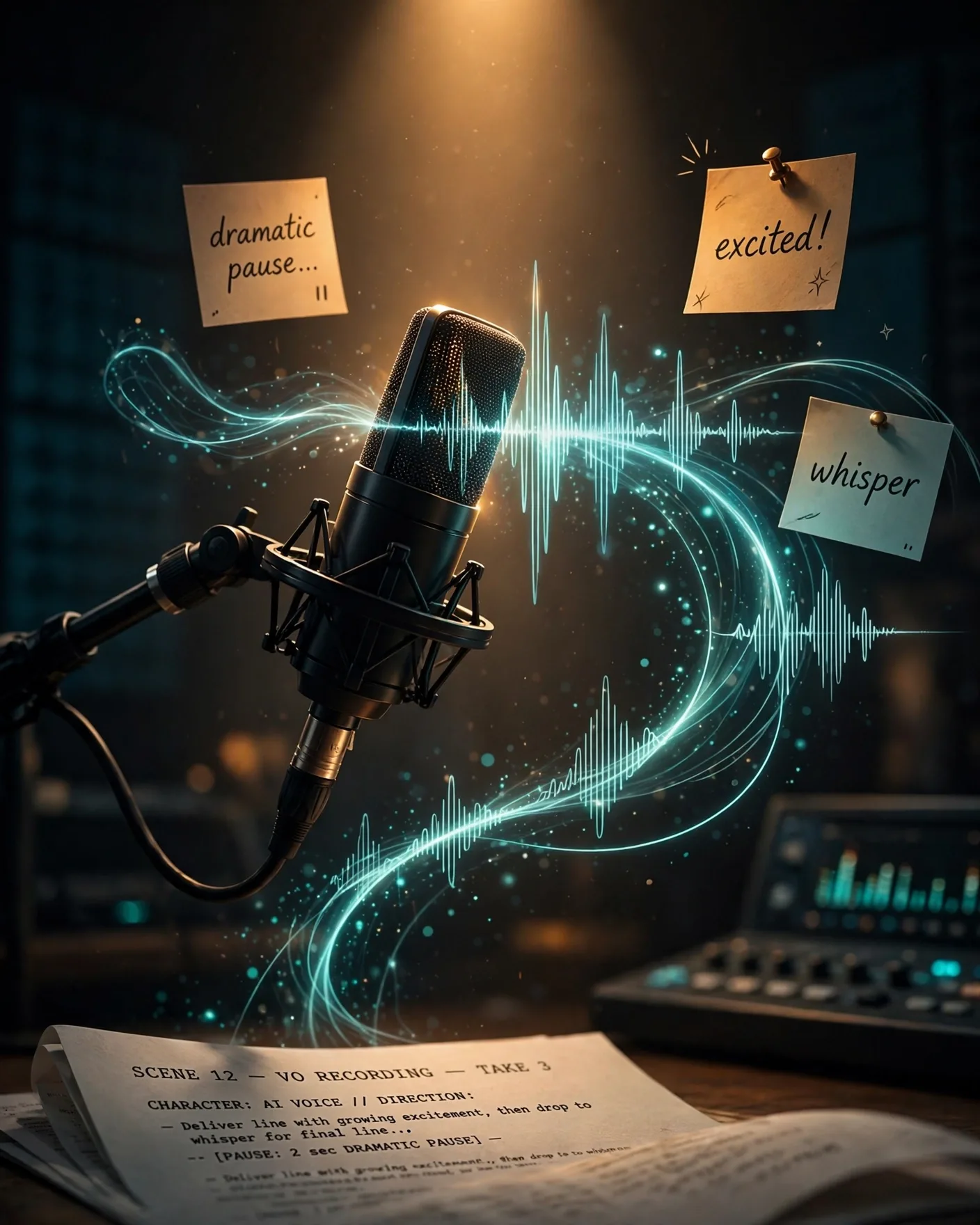
The biggest mistake in AI voice prompting is typing a script and pressing generate. Voice models — Suno Speech, ElevenLabs v4 and v4 Turbo — read your direction the way an actor reads a script brief: they need to know who is speaking, how they feel, how fast they move, and what is happening around them. Unclear emotion cues, flat pacing, and contradictory style instructions are the main failure modes across every TTS platform. Fix the direction and the voice follows.
The Prompt Formula: Character + Emotion + Pacing + Context
Every strong voice prompt answers four questions. Character: who is speaking — age, energy, register (a warm narrator in her 40s, not "female voice"). Emotion: the feeling underneath the words, stated plainly (quietly excited, not shouting). Pacing: speed and rhythm (slow and deliberate, quick punchy delivery). Context: what is happening (a product reveal, a bedtime story, a breaking-news alert). Miss one and the model improvises it — usually badly.
CHARACTER: warm male narrator, mid-30s, confident but friendly. EMOTION: quietly excited, like sharing a secret. PACING: medium tempo, brief pauses before key phrases. CONTEXT: introducing a new productivity app in a launch video. SCRIPT: "For three years, we asked one question: what if your to-do list actually helped you think? Today, it does."
Write Scripts That Perform Well
Punctuation is stage direction for voice models. Commas and periods control breath; line breaks create beats; ellipses slow a line to a crawl; an em dash inserts a sharp interruption. ALL CAPS or asterisks around a word usually trigger emphasis — use sparingly, because a model that emphasizes everything emphasizes nothing. Read every script aloud before generating: if you stumble, the model will too.
- Commas and periods: control breath and phrasing
- Line breaks: create dramatic beats between thoughts
- Ellipses: slow a line down, add weight
- Em dashes: sharp interruptions and pivots
- Sparing emphasis: cap or star ONE word per line, maximum
Directing Takes: Variety, Then Refinement
Modern tools give you take controls — Suno Speech's Advanced mode offers voice gender, speaking style, and take-to-take variety; ElevenLabs v4 exposes granular expression control. Use them deliberately: generate three takes with different style settings, pick the best, then refine only what is wrong. Regenerating the whole line because one word sounds off is wasteful — and most platforms now let you regenerate or adjust at finer granularity.
Voice Cloning Etiquette: Consent First
ElevenLabs v4 clones a voice from about 10 seconds of audio — powerful and genuinely risky. Only clone voices you own or have explicit permission to use, keep the consent record with the project, and never clone a recognizable public figure's voice for content that could mislead. The technology is ten seconds away from anyone's voice; the ethics have to be faster than the tool.
Five Copy-Paste Voice Prompt Templates
Steal these structures and fill in the brackets. Each follows the character + emotion + pacing + context formula.
AD VOICEOVER: [Character: energetic woman, late 20s] [Emotion: genuine enthusiasm, zero hype] [Pacing: quick, punchy, smile in the voice] [Context: 15-second social ad for a skincare serum] SCRIPT: "[Your lines here.]"
NARRATOR: [Character: calm man, 40s, documentary register] [Emotion: quiet wonder] [Pacing: slow, deliberate, long pauses] [Context: nature documentary intro] SCRIPT: "[Your lines here.]"
CHARACTER VOICE: [Character: mischievous kid, 10 years old] [Emotion: playful, conspiratorial] [Pacing: fast with sudden whispers] [Context: animated short, talking to the audience] SCRIPT: "[Your lines here.]"
Frequently Asked Questions
Which is better for voiceovers, Suno Speech or ElevenLabs?
Different strengths: Suno Speech (beta) generates spoken voice plus original background music as one track — ideal for content that needs a score. ElevenLabs v4/Turbo is the purer TTS choice with granular expression control across 90+ languages. Pick by whether you need music.
Why does my AI voiceover sound robotic?
Almost always the direction, not the model: missing emotion cues, no pacing variation, and flat scripts. Add the four-part formula (character, emotion, pacing, context) and format the script with punctuation as stage direction.
Can I clone my own voice for narration?
Yes — ElevenLabs v4 needs roughly 10 seconds of clean audio. Use your own voice or one you have explicit permission to clone, and keep the consent record with your project files.
How long can AI voice tracks run?
Suno Speech beta supports tracks up to about 8 minutes with voice and music combined. For longer narration, generate in sections and assemble — consistency holds better in short, well-directed takes.
Related Prompts
Rembrandt Noir Men's Portrait Prompt — Diagonal Light Beam (4:5)
ChatGPT
Surreal Universal Ad Template Prompt — Any Product, One Twist (4:5)
ChatGPT
Epic Automotive Collector Poster Prompt — Hero Car Key Art (4:5)
ChatGPT