





What NVIDIA actually launched
Nemotron 3.5 Transcribe is a speech-augmented language model built around the Nemotron 3.5 Lightning 30B-A3B hybrid Mamba-Transformer model, with about 4 billion active parameters per token. It pairs a speech encoder with a frozen diarization model, so speaker identity travels with the audio instead of being added afterwards. NVIDIA also released Granary v2, an open speech dataset and curation pipeline covering 463,062 hours across 48 languages.
One recording, four different outputs
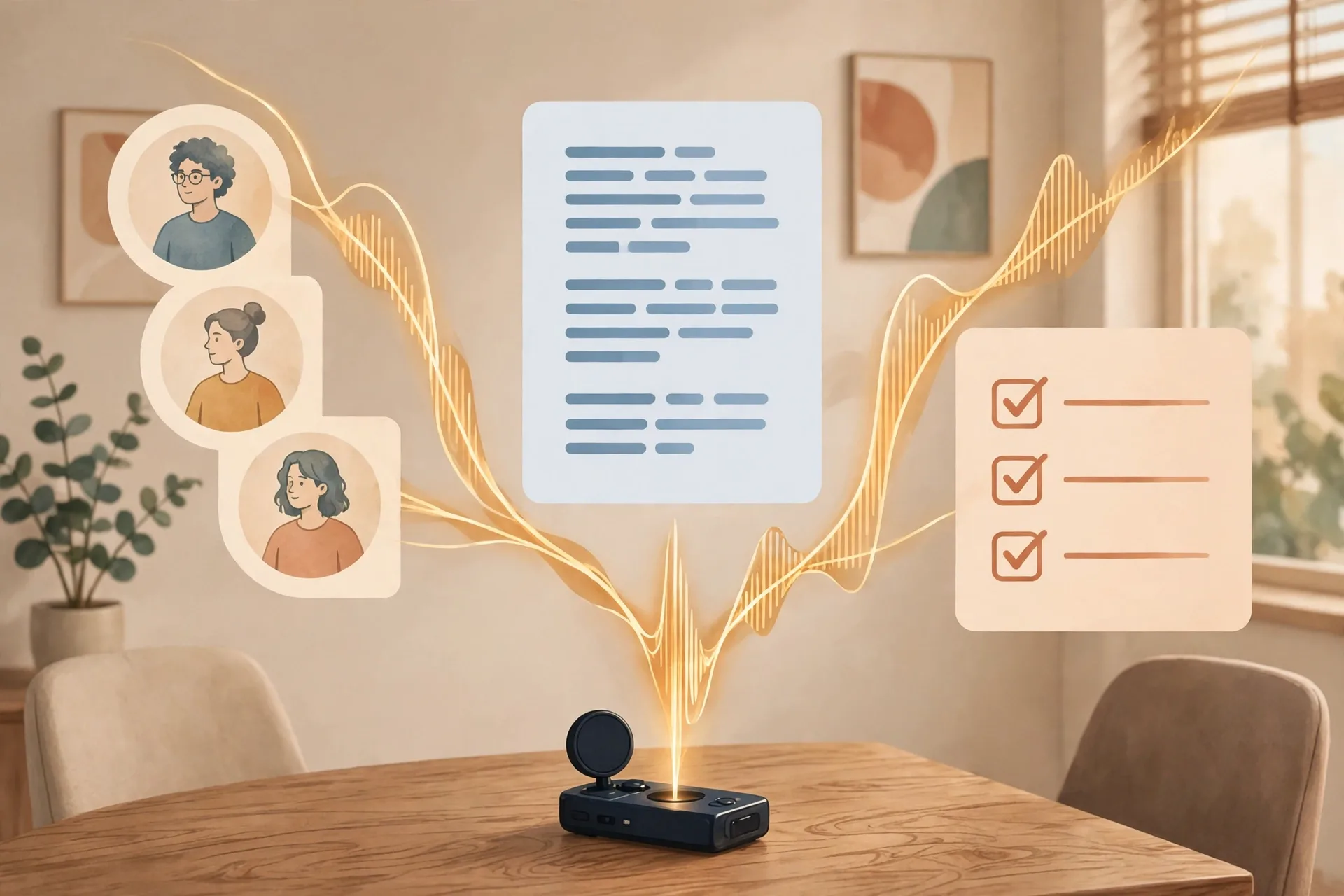
- Verbatim or cleaned-up transcription in 40 languages, on recordings up to one hour long
- Translation to or from English across 31 languages
- Speaker-attributed transcripts with word-level timestamps, up to eight speakers across 13 languages
- Audio question answering in English, such as asking what decisions were made in a meeting
The instruction decides the output. The same checkpoint can return a labelled transcript, an English translation, or a summary of decisions, without retraining — the prompt selects the format, the level of cleanup, and the vocabulary to prefer.
Why context prompting matters more than fine-tuning here
The model accepts a list of expected names, acronyms and domain terms in the prompt. NVIDIA reports this cuts named-entity errors six-fold on its ContextASR-Bench, which matters for medical, legal and financial recordings where one misspelled name ruins a transcript. Fine-tuning is still available through the NeMo framework, but for most teams a careful context list is the faster first step.
Where it runs
As an open-weight model under the OpenMDW-1.1 license, Transcribe can run on a single GPU, from a Jetson AGX Thor edge device and DGX Spark systems up to Blackwell data-centre hardware. Hosted endpoints and a Hugging Face demo are also available, and audio question answering is trained in English even though transcription covers 40 languages.
| Task | Coverage | Limit to know |
|---|---|---|
| Transcription | 40 languages | Recordings up to 1 hour |
| Translation | 31 languages to/from English | Style and terminology come from your instruction. |
| Speaker labels | 13 languages, up to 8 speakers | Overlapping speech is the hardest case — verify it. |
Transcribe this medical discussion in the original language. Possible terms: HbA1c, metformin. Use these terms only when supported by the audio. Preserve standard medical spelling and write numbers in conventional written form.
Frequently Asked Questions
Is Nemotron 3.5 Transcribe free to use commercially?
The weights are released under the OpenMDW-1.1 license, which NVIDIA presents as permitting commercial and non-commercial use. Check the model card licence text for your deployment before shipping a product on it, since hosted endpoints may carry their own terms.
Can it transcribe live streams?
No. Transcribe is built for recorded audio up to one hour long. NVIDIA's smaller Nemotron 3.5 ASR model is the streaming option, while Transcribe is the promptable file-based model.
How is it different from a normal speech-to-text API?
A normal API returns one fixed transcript style. Transcribe returns different outputs from the same recording depending on your instruction — verbatim, cleaned, translated, speaker-labelled, or answered — and it accepts context terms that shape spelling and terminology.
Which languages get speaker labels?
Speaker attribution covers 13 languages, including Arabic, Mandarin, English, French, German, Hindi, Italian, Japanese, Korean, Portuguese, Russian, Spanish and Thai. Transcription itself covers 40 languages.