
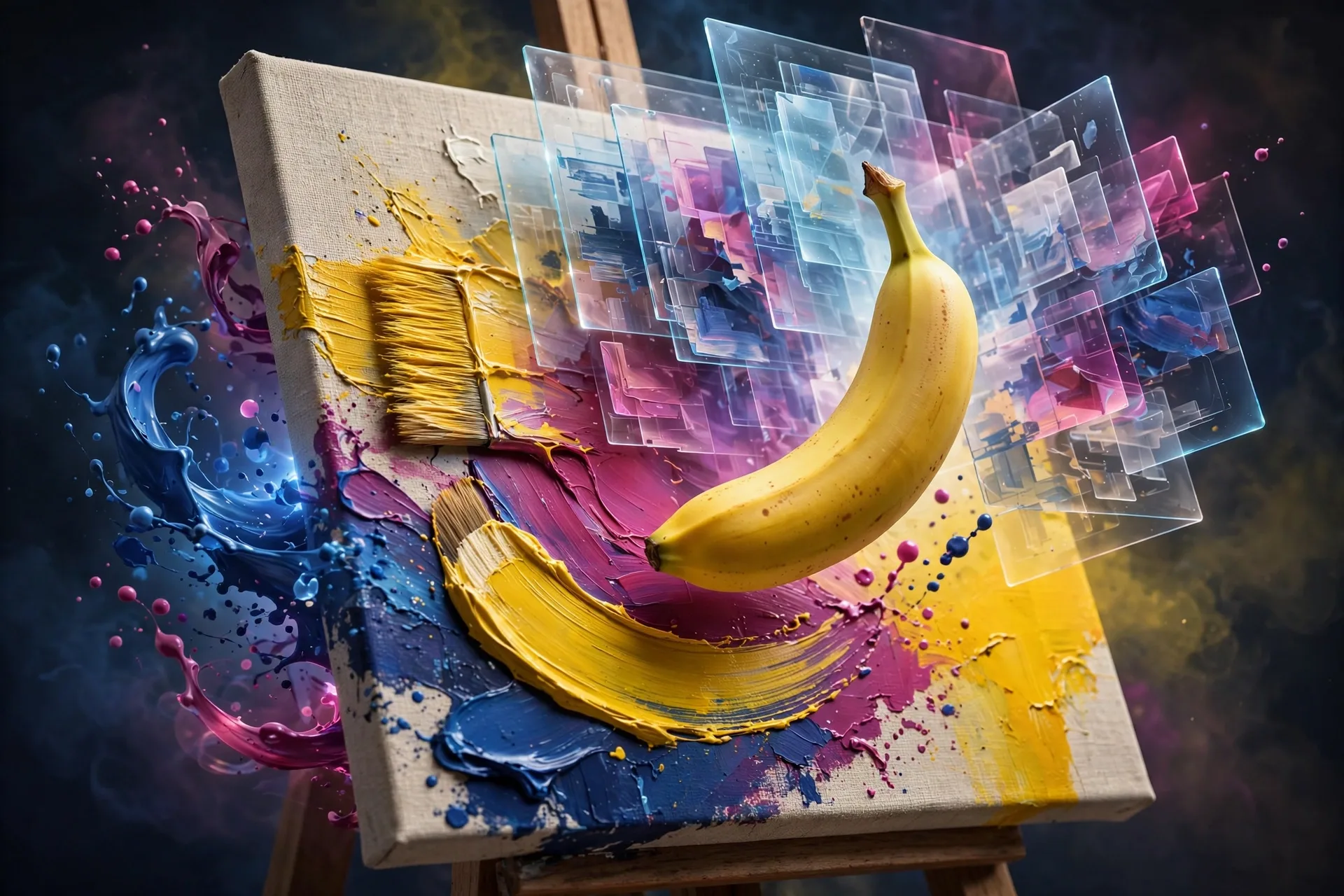
What Google launched
Nano Banana 2.1 is the update to Google's image generation and editing model family (built on Gemini 3.1 Flash Image, the generation behind "Nano Banana 2"), and it reached general availability on October 6, 2026. The model code is gemini-nano-banana-2.1. Google rolled it out the same day across the Gemini app, Search AI Mode, Google Ads, AI Studio, Flow, and Stitch — so if you generate images through any Google surface, you are likely already using it.
It accepts text, image, video, and PDF inputs and returns image plus text output. The big headline for creators: output resolutions now go to 1K, 2K, and 4K (1K is the default), and Google says it fixed the visible tiling artifacts that used to appear on ultra-wide ratios — 1:4, 4:1, 1:8, and 8:1 — at 2K and 4K. Panoramas and banner-style compositions should finally render clean.
The spec sheet
- Model code: gemini-nano-banana-2.1 (update to Nano Banana 2 / Gemini 3.1 Flash Image)
- Status: general availability from October 6, 2026
- Nano Banana 2 retires October 29, 2026
- Inputs: text, image, video, PDF
- Output: image + text
- Input limit: 131,072 tokens
- Output limit: 32,768 tokens
- Output resolutions: 1K / 2K / 4K (1K default)
- Ultra-wide tiling fix: clean 1:4, 4:1, 1:8, 8:1 at 2K/4K
- Configurable Thinking levels: minimal, medium (default), high
- Batch API support for bulk generation
Multi-image fusion: the feature that changes prompting
Nano Banana 2.1 can fuse up to 14 reference images in a single generation, with character consistency for up to 4 characters and object fidelity for up to 10 objects. In practice, that means you can supply a character's face, a product shot, a style reference, and a background as separate images and ask for one coherent scene — instead of hoping a single text description holds everything together. It also ships mask-based editing, so you can mark a region and change only that part of an image, plus improved overall visual quality.
Better text rendering and infographics
One of the most practical upgrades is text handling: Google says 2.1 delivers improved text rendering and more accurate infographic layout. Prompt-to-image models have historically mangled logos, signage, and multi-line captions; if you build posters, thumbnails, or diagram-style images, this is the version to test against your old outputs. For prompt writers, the implication is direct: you can now ask for specific text in the image with more confidence it will come back legible and correctly placed.
Grounding with Google Search
Nano Banana 2.1 supports grounding with Google Web and Image Search, which means generations can draw on retrieved real-world references — products, landmarks, logos — instead of hallucinating them from weights alone. If you have ever asked an image model for a specific real product and gotten a plausible-but-wrong object, grounding is the fix: tell the model to use search-grounded references for the parts of the image that must be accurate.
Thinking levels and the Batch API
A new configurable "Thinking" setting (minimal, medium default, high) trades generation speed against quality on complex compositions. Use minimal for quick drafts and high for multi-object scenes, fusion jobs with many references, or precision layout work. The Batch API, meanwhile, makes bulk workflows — thumbnail sets, ad variants, catalog imagery — practical at scale.
Nano Banana 2 vs 2.1 at a glance
| Capability | Nano Banana 2 (retiring Oct 29, 2026) | Nano Banana 2.1 (GA Oct 6, 2026) |
|---|---|---|
| Max resolution | Below 4K | 1K / 2K / 4K |
| Ultra-wide ratios | Tiling artifacts at high res | Fixed: clean 1:4, 4:1, 1:8, 8:1 at 2K/4K |
| Multi-image fusion | Limited | Up to 14 reference images |
| Character consistency | Basic | Up to 4 characters |
| Object fidelity | Basic | Up to 10 objects |
| Mask-based editing | Not available | Supported |
What prompt writers should do now
Three moves: migrate any Nano Banana 2 workflows before the October 29 retirement; switch complex compositions to high Thinking and reference-image fusion instead of longer text prompts; and re-test every prompt that renders text in-image — the improved rendering may let you shorten prompts that previously over-described typography. If you write editing prompts, the new mask-based editing deserves its own workflow — see our guide on writing mask-based image editing prompts.
Frequently Asked Questions
What is Nano Banana 2.1?
Nano Banana 2.1 (model code gemini-nano-banana-2.1) is Google's image generation and editing model released to general availability on October 6, 2026. It accepts text, image, video, and PDF inputs and produces images up to 4K, with multi-image fusion, mask-based editing, and improved text rendering.
Is Nano Banana 2 being discontinued?
Yes. Google is retiring Nano Banana 2 (Gemini 3.1 Flash Image) on October 29, 2026. If your prompts, apps, or workflows reference the old model, migrate to gemini-nano-banana-2.1 before that date.
What is multi-image fusion in Nano Banana 2.1?
The ability to supply up to 14 reference images in one generation — faces, products, style plates, backgrounds — with character consistency for up to 4 characters and object fidelity for up to 10 objects. It is the most reliable way to keep a character or product looking identical across a series of images.
What are Thinking levels in Nano Banana 2.1?
A configurable quality control with three settings: minimal, medium (default), and high. Higher Thinking spends more compute on complex compositions — multi-object scenes, fusion jobs, precise layouts — in exchange for slower generation. Use minimal for drafts, high for final renders.
Where is Nano Banana 2.1 available?
It rolled out on launch day across the Gemini app, Google Search AI Mode, Google Ads, AI Studio, Flow, and Stitch, plus the Gemini API and Batch API for developers.
Related Prompts
Conceptual Packaging Design Prompt — One Truth, One Clever Pack Idea
ChatGPT
Vintage Lithograph Poster Prompt — Two-Ink Print, Bold Posterized Art
ChatGPT
Event Poster Design Template Prompt — Any Theme, One Striking Layout
ChatGPT