What negative prompts actually do
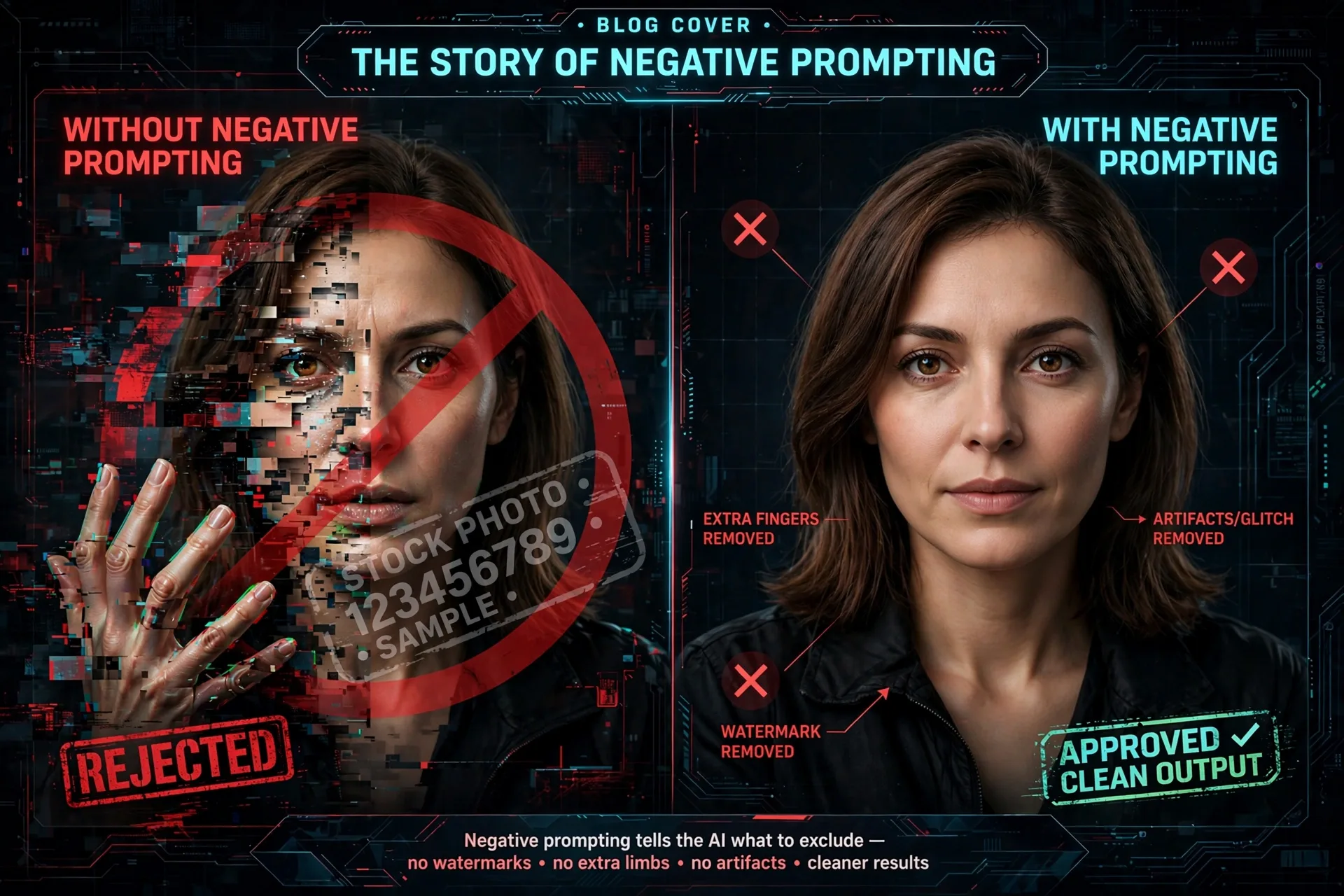
A negative prompt tells the image model what to steer away from. Diffusion models learn from millions of images — including bad ones — so without guidance they happily reproduce the failure modes in their training data: blurry faces, mangled hands, watermarks, gibberish text, murky lighting. A good negative prompt is a filter on the model's worst habits, not a second positive prompt.
When they matter most
Negative prompts pay off biggest in three situations: photorealism (where artifacts destroy believability), hands and faces (the model's weakest anatomy), and any image containing text or logos (where the model invents letterforms). For abstract or painterly styles, you can often skip them — the looser the style, the less the artifacts matter.
The universal starter block
Negative prompt: blurry, out of focus, low quality, distorted hands, extra fingers, deformed, mutated, disfigured, watermark, logo, text artifact, gibberish text, duplicated, cloned face, ugly, worst quality, pixelated, noisy, overexposed, underexposed
Why each term earns its place: "blurry / out of focus / low quality / worst quality / pixelated / noisy" target resolution and clarity failures. "distorted hands / extra fingers / deformed / mutated / disfigured" target anatomy failures — the most notorious artifacts in AI imagery. "watermark / logo" target branded artifacts from training data. "text artifact / gibberish text" target the model's habit of inventing letterforms. "duplicated / cloned face" target repetition artifacts. "ugly" is blunt but effective as a general quality anchor.
Scenario-specific negatives
Start from the universal block, then add terms for your scenario. Portraits: add "asymmetrical eyes, crossed eyes, unnatural skin texture, plastic skin, double chin, crooked teeth." Product shots: add "floating product, warped packaging, misaligned label, reflections of camera, cluttered background." Anime: add "3d render, photorealistic, extra limbs, fused fingers, uncanny." Architecture: add "crooked lines, warped perspective, melting building, impossible geometry, floating elements."
| Scenario | Add to the universal block |
|---|---|
| Portraits | asymmetrical eyes, crossed eyes, plastic skin, crooked teeth |
| Product shots | floating product, warped packaging, misaligned label, cluttered background |
| Anime | 3d render, extra limbs, fused fingers, photorealistic |
| Architecture | crooked lines, warped perspective, impossible geometry |
Model differences (honestly stated)
Not every model treats negative prompts the same. Midjourney supports a dedicated negative weight via the --no parameter (e.g. --no watermark, text), which is cleaner than appending negative text. Classic Stable Diffusion-style models have a separate negative prompt field — that's where the format above shines. ChatGPT and DALL-E-style models generally don't have a separate negative prompt field; you fold exclusions into the positive prompt ("no watermark, no text, no distorted hands"). Nano Banana and similar conversational image tools work best with natural-language exclusions rather than comma lists. Always check your model's interface before assuming the block format will work.
Common mistakes
- Overloading negatives — 30+ terms dilute the signal; 8–15 focused terms work better.
- Negating your main subject — "no people" in a portrait prompt fights your own prompt.
- Using negatives as a crutch for a weak positive prompt — describe what you want first, exclude second.
- Copy-pasting the same block into every model — interfaces differ.
- Negating style terms — "no photorealism" rarely works as well as stating the style you do want.
Frequently Asked Questions
Do I always need a negative prompt?
No. They matter most for photorealism, hands, faces, and text-heavy images. For abstract, painterly, or stylized work, the artifacts are less visible and you can often skip them — or keep a short 5-term list for safety.
How long should my negative prompt be?
Aim for 8–15 focused terms. Longer lists dilute the signal and can confuse the model. Start with the universal block, trim what doesn't apply to your scenario, and add only scenario-specific terms that target known failure modes.
Why don't negative prompts work in ChatGPT?
ChatGPT's image generation doesn't have a separate negative-prompt field. Instead, fold exclusions into your positive prompt as natural language: "no watermark, no text, no distorted hands." It's the same idea, just phrased as part of the main description.
Can negative prompts remove people or objects from the scene?
Poorly. Negatives steer the model away from failure modes, not from your own subject matter. If your prompt asks for a portrait and you negate "people," the model gets contradictory signals. Remove unwanted subjects by rewriting the positive prompt instead.
What's the single most important negative term?
For photorealistic work, "distorted hands" or "extra fingers" — hands remain the most recognizable AI artifact. For general quality, "blurry" and "low quality" are the highest-value pair.
Related Prompts
Vector Fashion Editorial Illustration Portrait Editable AI Prompt
ChatGPT
Street Dance Fashion Illustration Editorial Editable AI Prompt
ChatGPT
Illustrated Athlete Giant Sneaker Mustard Poster Ad Editable AI Prompt
ChatGPT