
Why Photorealism Is the Hardest Setting
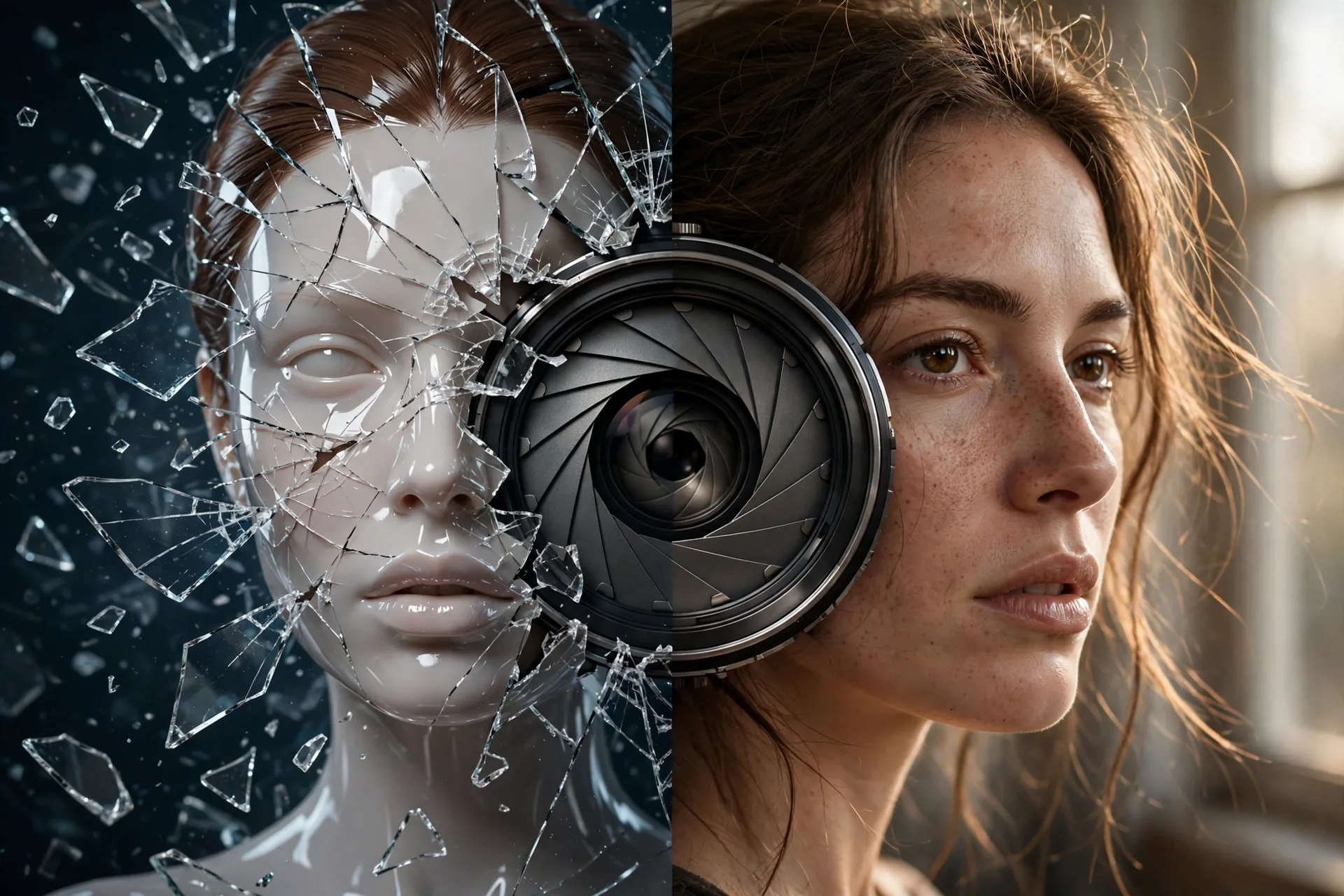
Stylized art is forgiving — a slightly off hand reads as the artist's choice. Photorealism has no cover: human eyes are tuned to spot skin that looks like plastic, teeth that are too even, reflections that don't match the light source, and lighting that doesn't wrap the face correctly. Leaderboards built on head-to-head human voting matter more than automated metrics for this reason. Your prompt has to fight the model's default "smooth beauty" instinct on every front.
The 7-Part Photoreal Portrait Formula
- Subject identity: age, gender, expression, ethnicity, distinctive features
- Camera language: 85mm portrait lens, shallow depth of field, shot on full-frame DSLR
- Lighting: window light, golden hour, Rembrandt lighting — name the exact light and direction
- Skin and texture truth: natural skin texture, visible pores, subtle blemishes, no airbrushing
- Environment context: what surrounds the subject, background blur (bokeh)
- Imperfection anchors: stray hair, freckles, wrinkles, fabric folds
- Negative constraints: no plastic skin, no over-smoothing, no uncanny eyes, no warped teeth
Photorealistic portrait of a woman in her 60s, gentle smile with natural laugh lines, freckles across her nose, silver-streaked hair pulled back loosely, shot on 85mm lens with shallow depth of field, soft window light from the left wrapping her face, natural skin texture with visible pores, cotton blouse with fabric folds, blurred warm kitchen background, candid photograph, no airbrushing, no plastic skin, no oversmoothed face
Light the Face Like a Photographer
Models default to flat, even lighting that looks digital. Name the light's source, direction, and quality: "soft diffused window light from the left", "golden hour backlight with warm rim", "overcast daylight with gentle fill". Then match the environment to it — the background bokeh should glow in the same direction as the key light. Mismatched light direction on face versus background is the fastest tell that a portrait is AI.
| Lighting setup | Mood it gives | Prompt phrase |
|---|---|---|
| Window light, side | Natural, honest | "soft window light from the left, gentle shadow on one cheek" |
| Golden hour backlight | Warm, cinematic | "golden hour rim light through hair, warm glow on shoulders" |
| Overcast daylight | Soft, editorial | "diffused overcast light, minimal shadow, neutral skin tone" |
| Rembrandt key | Dramatic, classic | "Rembrandt lighting, triangle of light on the shadowed cheek" |
The Three Classic Fakes and Their Fixes
Plastic skin means you forgot texture anchors — add "visible pores, natural skin texture, subtle blemishes". Dead eyes come from vague eye direction — name it: "looking slightly off-camera, catchlights in both eyes". Wrong background happens when you describe the person but not the space — one line of environment ("blurred street cafe at dusk behind her") grounds the portrait in a world the light can belong to.
“If your prompt couldn't be handed to a photographer as a shoot brief, it's not specific enough to fool anyone.”
Frequently Asked Questions
Why do my AI portraits look plastic or airbrushed?
Because the model's default is beautified smoothness. Fight it with texture anchors: "natural skin texture, visible pores, subtle blemishes, fine wrinkles, no airbrushing". Name imperfections explicitly — freckles, laugh lines, stray hairs — and the smoothing instinct breaks.
What lighting gives the most realistic portrait?
Soft directional light — window light from the side is the most forgiving and natural-looking. Name the source and direction explicitly, then make the background's light direction match. Overcast daylight also works well for soft editorial realism.
Should I ask for "8K ultra detailed" for realism?
Not alone. Resolution words without texture instructions just make a sharper fake. Always pair them with skin-texture truth and imperfection details — pores, fabric folds, flyaway hair — which are what actually read as photographic reality.
How do I fix weird eyes or teeth in portraits?
Be specific: "looking slightly off-camera, natural catchlights", "gentle closed-lip smile" or "natural teeth, no over-whitening". Avoid extreme close-ups for teeth, and never describe teeth as perfect — the model interprets perfection as uncanny.
Related Prompts
Conceptual Packaging Design Prompt — One Truth, One Clever Pack Idea
ChatGPT
Vintage Lithograph Poster Prompt — Two-Ink Print, Bold Posterized Art
ChatGPT
Event Poster Design Template Prompt — Any Theme, One Striking Layout
ChatGPT